Tuesday, 12 February 2013

Strobe photography - Balloons


To get these images it was very hard, we had a water balloon tied to a stand above a bin to catch the water. I set the camera to a 10 second shutter speed, I pressed the button to set off the shutter. At some point in the 10 seconds one of my friends would use a stick that had a pin on the end to poke the balloon so it would burst but at the same time someone else would press the button on the light to make it flash. You have to press the flash at the same time has you burst the balloon or you wont get it bursting.


ISO- 100
F 22
Shutter speed - 10 seconds
I used photoshop to edit this image first  I removed the stick then I added more contrast into the image. I also changed the colour of the balloon.


ISO- 100
F 22
Shutter speed - 10 seconds
I used photoshop to edit this image first  I removed the stick then I flipped this image upside down as it looks better. I added more contrast and added a bit of colour.


Monday, 4 February 2013

High and Low Key Photography


High Key 
High key images are normally associated with happiness, therefore a lot of high key photography can be found in family and children portraits as well as a lot of product photography. 
High key is a lighting technique where images are bright and not too contrasted. High key photos have bright tones and a lack (or absence) of shadows.


It works well when shooting portraits, still life and product photos. In order to get a high key image you will need a soft box (or two, both pointing at your subject) and another two lights (soft boxes) facing the background to overexpose the back and this should create a high key portrait.

I set my camera on:
ISO-100
F.8
S (TV)- 1/125
Using two soft boxes lighting the back and two soft boxes to light the person.


Low Key
Low key is a image that has a subject that the lighting is focused on the subject and the background is dark/black.

ISO- 100
F 11
Shutter speed - 1/60


In this image i used a black backdrop and and one soft box on the left of the model to light her.


I used the same lighting on this however my camera setting were different that's why the background has tones of gray and then black.
ISO- 100
F 6.3
Shutter speed- 1/125


Mid Key
Mid key is an image that has gray tones in the background.


This image shows mid key as the background is gray however a white backdrop was used. I used two soft boxes in this image both at the front of the model pointing at her.
ISO- 100
F 7.1
Shutter speed- 1/125


Thursday, 17 January 2013

Studio Equiptment

Lights 


Tungsten

Tungsten lighting is a form of hot or continuous lighting in studio applications. Some digital still photographers and portrait photographers prefer tungsten lighting for its consistency. Tungsten lighting creates a moody type photo. This is a photo of me done by Julie using tungsten lights, I like how moody the photo is as that partly shows my personality. 


I took this photo of Mollie using tungsten light and having the barn doors shut in so that its just points and her face. I think this image is really good as I like how the right side of her face is mainly just black and the light was only hitting her left side.


Barn doors 

Barn doors attach to a tungsten light and they move in and out so that you can control how much light is in the image and where is goes to.


Soft Box

Soft boxes are used to diffuse light, they can spread light across an area and this can soften shadows. Soft boxes come in different shapes and sizes.


Beauty Dish


The beauty dish is used for portrait and fashion photography, it creates a dramatic light that wraps around your subject's face giving a classic look to portrait photography.


Reflectors

Reflectors are used to bounce light back onto the subject. They come in many different colours, this can create different shadows on the subject, eg the gold reflector will add warm tones whereas the black reflector will add more shadow and dark tones.


Monday, 10 December 2012

Our project - FUN

Just like Gilbert and George work together, we got our next project that meant we had to work in a group of 7 and create large art work. Ideas changed and developed, we got ideas from books and the internet. 
Some of our ideas were

  • stereotypes 
  • showing how old people respond to today's youth 
  • showing how time has changed 
  • fun 
Our final idea is fun, this is shown by images of objects that we find fun or that we did when we were younger, fun places and by portraits of us having fun. It was then suggested that we use a word like "us" or "me" but then it was pointed out that it may be too personal if we use words like that so we voted and "fun" is the word we're using. We're going to use 65 frames (size 6 x 4), having 13 across and 5 down. All the images will be black & white, however we're going to create the word FUN using the frames and images, these will be in red. It was then decided that each letter was going to be a different colour, "F" in red "U" in yellow and "N" in blue. 
We set deadlines for ourselves these were 

  1. Monday and Tuesday shoot the images 
  2. Tuesday afternoon and Wednesday edit
  3. Thursday print, frame and put on the wall. 
We met our deadlines and I think it looks really good and the word FUN stands out a lot. Here are some images of our work that are now up in college.


Here you can see our FUN image and the other groups image, theirs is to do with the 80's.


Sunday, 9 December 2012

Gilbert & George


England is a large, wall work consisting of thirty photographic panels mounted in abutting narrow black metal frames. The artists took photographs of a wild English rose and its leaves and coloured the photographs red and green respectively. The photograph of the rose, spread across two red panels, is central to the work. A cluster of three leaves is spread across four green panels above and below the rose. Black and white photographs of the artists standing in confrontational poses, their feet wide apart and their hands balled into fists, fill six panels on either side of the rose. They are making ‘a physical salute’ to England, one which involves ‘all the physique, not just an arm’ (quoted in The Tate Gallery 1980-82: Illustrated Catalogue of Acquisitions, p.99). Gilbert and George photographed each other against a white wall. The bottom of their legs and their feet disappear into the dark floor, which provides a kind of sculptural base for their figures. Above each black and white standing figure is a crouching, grimacing red and black figure. The image of Gilbert is placed above George and that of George above Gilbert in the compositional balancing typical to the artists’ multi-panelled photo-works of the 1970s. Gilbert, on one side, screws up his eyes and has his thumbs in his ears and his fingers sticking up above his head. George on the other side opens his eyesngland is a large, wall work consisting of thirty photographic panels mounted in abutting narrow black metal frames. The artists took photographs of a wild English rose and its leaves and coloured the photographs red and green respectively. The photograph of the rose, spread across two red panels, is central to the work. A cluster of three leaves is spread across four green panels above and below the rose. Black and white photographs of the artists standing in confrontational poses, their feet wide apart and their hands balled into fists, fill six panels on either side of the rose. They are making ‘a physical salute’ to England, one which involves ‘all the physique, not just an arm’ (quoted in The Tate Gallery 1980-82: Illustrated Catalogue of Acquisitions, p.99). Gilbert and George photographed each other against a white wall. The bottom of their legs and their feet disappear into the dark floor, which provides a kind of sculptural base for their figures. Above each black and white standing figure is a crouching, grimacing red and black figure. The image of Gilbert is placed above George and that of George above Gilbert in the compositional balancing typical to the artists’ multi-panelled photo-works of the 1970s. Gilbert, on one side, screws up his eyes and has his thumbs in his ears and his fingers sticking up above his head. George on the other side opens his eyes wide behind his glasses, sticks out his tongue and points towards his face. The artists transformed their childish gestures of mockery and rebellion into caricatured horror by lighting themselves from below and colouring the images red. Positioned above the proud patriots, the red artist-gargoyles seem to evoke their sinister alter-egos. - From the Tate website 


 In 1984 George explained:

We use colour in different ways. At first we used red and then we used red and yellow. Now we use more colours, but in each picture they mean something different. It depends on how we put them to work. They can be symbolic or they can be atmospheric or emotional. You can say red is like love, or it is like blood, or danger, or fire. It’s used in different ways, not in a simplistic way. It’s more a part of our own language, really – part of our vocabulary.


Monday, 3 December 2012

Richard Billingham

'my father raymond is a chronic alcoholic.
he doesn't like going outside, my mother elizabeth hardly drinks, 
but she does smoke a lot.
she likes pets and things that are decorative.
they married in 1970 and I was born soon after.
my younger brother jason was taken into care when he was 11,
but now he is back with ray and liz again.
recently he became a father.
'dad was some kind of mechanic, but he's always been an 
alcoholic. it has just got worse over the years. 
he gets drunk on cheap cider at the off license. 
he drinks a lot at nights now and gets up late.
originally, our family lived in a terraced house, 
but they blew all the redundancy money and, in desperation, 
sold the house. then we moved to the council tower block, 
where ray just sits in and drinks. 
that's the thing about my dad, there's no subject he's interested
in, except drink.'

'it's not my intention to shock, to offend, sensationalise, 
be political or whatever, only to make work that is as spiritually 
meaningful as I can make it - 
in all these photographs I never bothered with things like 
the negatives. some of them got marked and scratched. 
I just used the cheapest film and took them to be processed 
at the cheapest place. I was just trying to make order out of chaos.' - Richard Billingham 


 Richard's dad Ray was an alcoholic, in this image I think that this is clear, he's at the point where he can't stand and we get the feeling like he's like this a lot of the time. 

I like the expression on the faces in this image because of Rays drinking, Ray and Liz (Richard's mother) argued a lot and I like how this has been captured here.

His mother over ate and had many tattoos. 


Here again we see Ray drunk and he's like pushed the cat into the air, I think this is the best image as it has a comical feel to it. 

Family photos

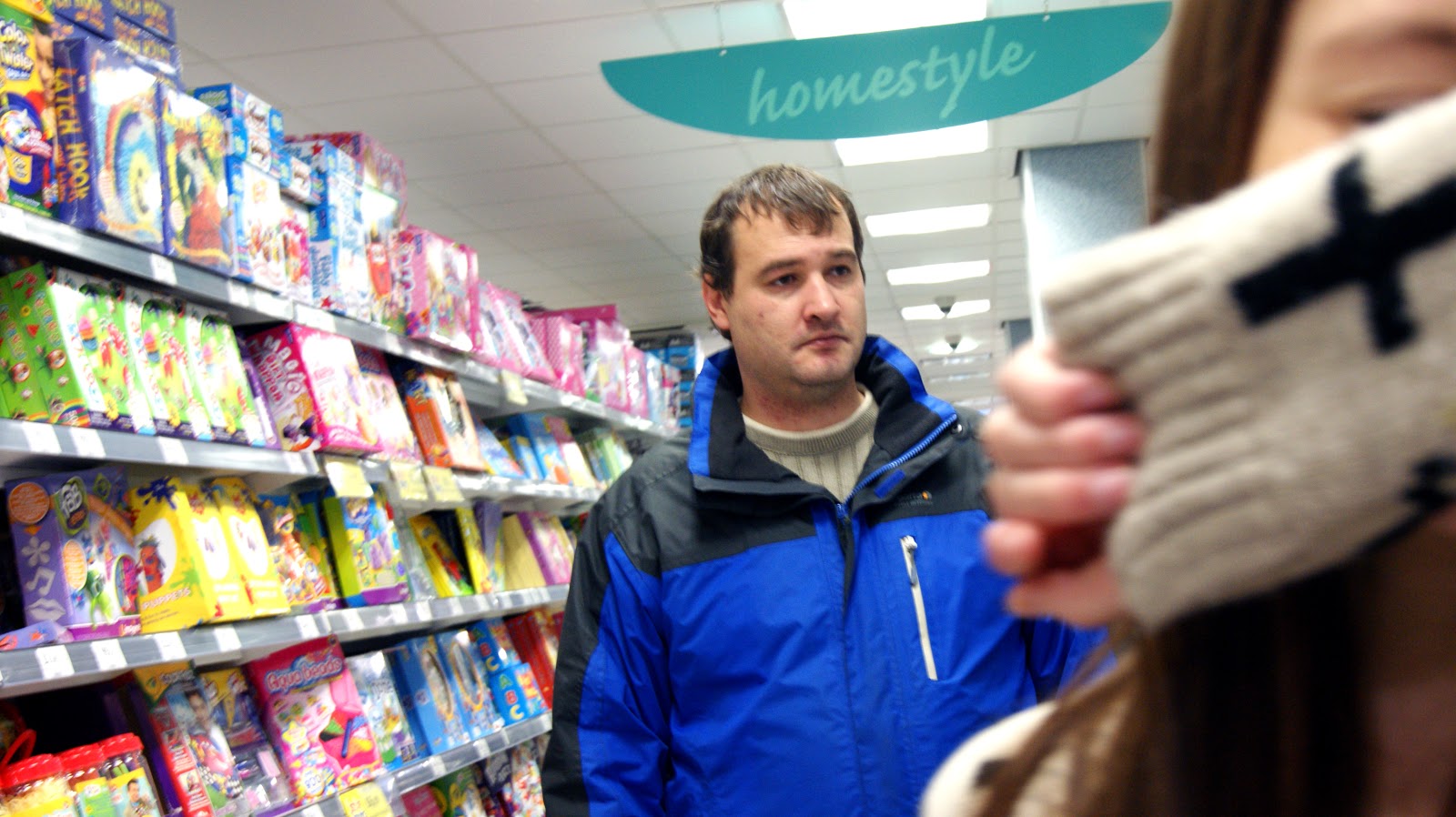
 Photos of my family that I took in Home Bargains and in my cousin's house, I then edited them in Photoshop and/or adobe bridge. I think these image show a 'normal' family day life.


I like the diagonal lines that lead you to my family and also how the left side of the photo is clear and it gets lighter as the image goes showing good shallow depth of field.

 Doing a bit of Christmas shopping, in this image I like the leading lines that take you to the person ( my aunty Gillian).


I like the motion of the book in this image. 
This image shows my family setting, all sitting around watching the kids 
 In this image I like how my cousin Emma is in focus but the rest is in blur or motion. It's juxtaposition between chaos in the background and calm in the stillness of Emma.

I also made the image black and white, I think it looks better like this.


In this image Caleb had noticed the camera and started to shout, I used photoshop to edit.


I like this image because I just think its cute and natural. 


In this image there is my cousin Jon, his wife Lauren and their child Caleb, I like the similarities between mother and son, both on technology.